
Healthcare innovation has no shortage of ambition, but it often lacks context. Too many products are built around clinicians instead of with them, and too many care models optimize for scale before they understand the realities of patients, providers, and systems.
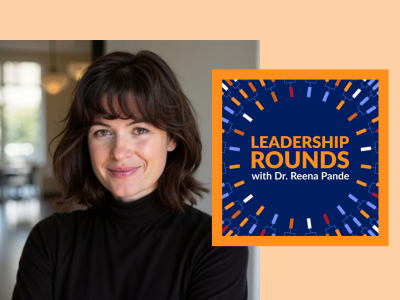
In a standout episode of Leadership Rounds, Rebecca Mitchell, MD, physician, clinical product pioneer, and co-founder of Scrub Capital, joins Oxeon’s Dr. Reena Pande for a wide-ranging conversation about what it really means to lead at the intersection of clinical care, technology, and venture capital.
Rebecca’s career offers a blueprint for the next generation of healthcare leaders: clinicians who operate across domains, build alongside technologists, and shape the future of care delivery from the inside out.
Rebecca’s story begins far from Silicon Valley. She grew up in rural northern Wisconsin in a healthcare desert marked by hospital closures, long wait times, and limited access to specialty care. Those early experiences, combined with later work in global health settings, gave her an unfiltered view of healthcare inequity and the limits of traditional delivery models.
During her training at UCSF, Rebecca became involved in the LifeWrap project, an innovation that adapted NASA technology to prevent maternal deaths from hemorrhage in low-resource settings. The project brought together nurse midwives, clinicians, materials scientists, and researchers, and ultimately went on to save lives around the world. The lesson was formative, teaching her that deeply understanding context (and building across disciplines) creates solutions that scale with integrity.
Rather than following a traditional clinical path, Rebecca made a then-unconventional pivot into product leadership. Long before “clinical product leader” was a recognized role, she began building and leading digital and virtual care products at both startups and public companies for platforms that now reach tens of millions of patients globally.
In her conversation with Reena, Rebecca is clear about what clinicians uniquely bring to product and business roles:
These skills, she argues, translate directly into better product decisions, clearer strategy, and more durable businesses. And yet, clinicians stepping into these roles still face bias, dealing with subtle and overt assumptions that they should “stay in their lane.” Rebecca’s experience shows that the most impactful leaders refuse that framing, instead holding themselves accountable for both clinical and business outcomes.
One of the episode’s central themes is the danger of false binaries in healthcare innovation: clinical vs. business, insiders vs. outsiders, operators vs. technologists. Rebecca and Reena agree that the strongest teams reject this thinking entirely. High-performing health tech organizations intentionally pair clinician insiders who understand care delivery, risk, and quality at a visceral level with operator and technologist outsiders, who bring expertise in systems design, distribution, and scale. When these perspectives are treated as equal and aligned around shared accountability, innovation accelerates without sacrificing trust or safety. This “T-shaped” model of leadership and teaming is increasingly essential as healthcare grows more complex, more digital, and more interdisciplinary.
Rebecca’s move into venture capital wasn’t a departure from her mission. It was an extension of it. As co-founder of Scrub Capital, she leads an early-stage fund built on a simple but powerful thesis: healthcare companies are better built, chosen, and supported when clinicians are deeply involved in investing and governance.
Scrub Capital’s model incorporates the expertise of more than 900 clinicians, founders, and operators into investment diligence and portfolio support. These clinician-builders don’t just advise, but actively shape decisions around product design, care models, go-to-market strategy, and leadership hiring. Rebecca points to a growing signal across the industry: many of the most successful healthcare companies have clinicians in founder or critical executive roles. Scrub Capital formalizes that insight into a repeatable, community-driven approach to venture.
Beyond the fund itself, Rebecca discusses Scope Collaborative (formerly Clinicians in VC), a community designed to support clinicians exploring roles in product, operating leadership, and investing. The goal isn’t to turn every clinician into a venture capitalist. It’s to expand what “practicing at the top of your license” can mean in a tech-enabled healthcare system. Through exposure, skill-building, and peer learning, Scope helps clinicians develop fluency in business, product, systems thinking, and other capabilities that healthcare increasingly demands.
Looking ahead, Rebecca argues that we are entering a once-in-a-generation moment. Technology (and increasingly AI) can meaningfully close care gaps that once felt insurmountable, but only if clinicians help design, govern, and lead these systems. In an era of human-plus-machine care, practicing at the top of your license includes shaping how tools are built, how decisions are made, and how safety and equity are protected at scale.
As Rebecca puts it:
“Technology can close the care gap if we build it with clinicians, not around them.”
At Oxeon, we work closely with the clinician-operators, product leaders, and executives who are navigating this exact transition. Rebecca’s story underscores what we see every day: the future of healthcare leadership is cross-functional, mission-driven, and deeply informed by frontline experience. For clinicians considering broader leadership roles, founders building in health tech, and investors backing the next generation of care models, this episode reminds us that the most durable healthcare innovation starts with those who understand care from the inside.
Listen on Spotify or Apple Podcasts
Rebecca Mitchell, MD is a physician-turned-digital health innovator and investor who has devoted her career to ensuring that high-quality scientific advancement and medical care reach every person, regardless of birthplace or means. Raised in a “healthcare desert,” Rebecca pursued a formal medical training and applied her clinical insight to some of the most under-resourced healthcare settings in the world, making her understanding of the scale of suffering and the potential for change crystal clear and deeply personal. As one of the first clinical product leaders in digital health, Rebecca has built and led digital and virtual care products at both startup and public companies with products that now reach tens of millions of patients worldwide. Alongside building these platforms, she has coached teams on how to embed clinical expertise directly into technology companies, bridging the gap between front-line care experiences and digital innovation.
Rebecca is a founding partner of Scrub Capital, an early-stage venture fund that operates on the belief that seasoned clinicians (not just traditional investors) are the key to early-stage health-tech company building. Under her leadership, Scrub Capital has mobilized a community of hundreds of clinicians, founders, and operators whose collective perspectives inform both investment decisions and post-investment portfolio support. Rebecca currently blends her clinical background, product-building experience, and investment leadership to back and build solutions that not only scale, but honor clinical integrity, equity, and impact.


