
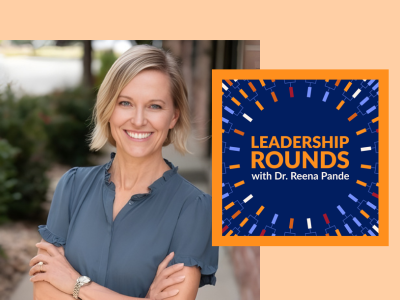
Healthcare is in the midst of a structural shift. Care is increasingly distributed. Teams are cross-functional by default. AI is no longer theoretical. And clinicians are being asked to lead not just at the bedside, but across product, operations, and strategy. In this episode of Leadership Rounds, Dana Udall, Chief Clinical Officer at Nourish, joins Oxeon’s Dr. Reena Pande for a candid conversation about what it really takes to scale care responsibly without losing clinical integrity, culture, or trust. Dana’s career spans clinical practice and senior operating roles, including leading clinical organizations through massive growth and complexity at Ginger (through its merger with Headspace) and Included Health. Across each chapter, a throughline emerges: scale only works when it’s intentional.
Dana’s pivot from traditional clinical work to platform leadership wasn’t driven by ambition: it was driven by reality. A perpetually full waiting room made one thing clear: no matter how skilled the clinician is, one-to-one care alone cannot meet population-level needs. That realization pushed her toward scalable, data-enabled models of care, first in digital mental health, then in broader virtual and integrated care delivery. The goal wasn’t to replace clinicians with technology, but to design systems that let clinicians extend their impact safely and sustainably. Scaling care is not about doing less clinically. It’s about designing infrastructure that allows clinicians to do more with integrity.
One of the most resonant ideas in the conversation is Dana’s distinction between intentional leadership and what she calls “pure authenticity.” Drawing on her background in Acceptance and Commitment Therapy (ACT), Dana argues that leadership isn’t about reacting emotionally in the name of authenticity. It’s about responding intentionally, grounded in values, aware of context, and aligned with long-term goals. In fast-moving, high-stakes healthcare environments, this distinction matters. Leaders set the emotional tone for their organizations, whether they intend to or not. Intentionality creates psychological safety while still allowing teams to move decisively. Clinician leaders don’t need to suppress emotion, but they do need to choose responses that serve both people and outcomes.
Dana and Reena dig into the mechanics of scaling distributed care, where clinicians may never share a physical office, and culture must travel digitally.
Three operating principles stand out:
From recruiting and onboarding to quality assurance and performance feedback, nothing can be left to chance. Distributed teams require more structure, not less.
Leaders can’t improve what they can’t see. Robust data systems allow organizations to monitor clinical quality, identify risk early, and intervene before small issues become systemic failures.
In high-growth healthcare companies, culture isn’t a “soft” concern; it’s an operating advantage. Leader vulnerability, whole-self norms, and clear values create trust and retention in environments where burnout is otherwise inevitable.
One of the most practical leadership takeaways from the episode is Dana’s emphasis on the first-team mindset. Clinical executives cannot operate solely as advocates for their function. They must see themselves first as enterprise leaders. That means speaking the language of Product, Commercial, Finance, and Operations, and understanding how clinical decisions ripple across the business. Dana is clear: the future belongs to healthcare executives who happen to be clinicians, not clinicians confined to clinical lanes. Credibility at the executive table comes from shared accountability, not siloed expertise.
Dana also speaks openly about her recovery from an eating disorder and why sharing that story matters in leadership. By naming lived experience, she reduces shame and brings nuance to her work at the intersection of mental and physical health, including how food, metabolism, and behavior are discussed in care models. This isn’t vulnerability for vulnerability’s sake. It’s leadership that integrates personal insight with professional responsibility, helping teams design care that reflects real human complexity.
For clinicians considering operating or executive roles, Dana offers practical guidance:
Looking ahead, Dana is clear-eyed about AI’s expanding role. Beyond documentation and workflow automation, AI will increasingly influence treatment decisions themselves.
That makes clinician leadership non-negotiable. Clinicians, ethicists, legal experts, and operators must co-design guardrails that keep patient safety and trust at the center of innovation.
The future of AI in healthcare cannot be governed solely by technologists.
At Oxeon, we work with leaders navigating exactly these tensions: scale vs. quality, speed vs. trust, innovation vs. integrity. Dana perspective offers a blueprint for clinician leadership in this next era—one grounded in intention, systems thinking, and deep respect for the realities of care delivery. For clinicians, operators, founders, and investors alike, this episode is a reminder: how we scale care matters just as much as whether we scale at all.
Listen on Spotify or Apple Podcasts
Dr. Dana Udall is the Chief Clinical Officer at Nourish, where she leads clinical strategy to scale outcomes-driven nutrition care. Over her 25-year career in health care, she has held numerous leadership roles, including Chief Clinical Officer at Headspace, Chief Clinical Officer at Ginger, VP of Behavioral Health at Included Health, and Clinical Specialty Services Lead at the University of Colorado, where she oversaw the eating disorder, substance use, behavioral health, and assessment teams.
As a licensed Psychologist, Dana spent much of her early career helping people with food, body image, and eating disorders. In addition to clinical work, she has published on these topics and provided extensive training to students, parents, clinicians, and educators. She holds a PhD from the University of Southern California and completed pre- and postdoctoral training at the University of Pennsylvania.


