
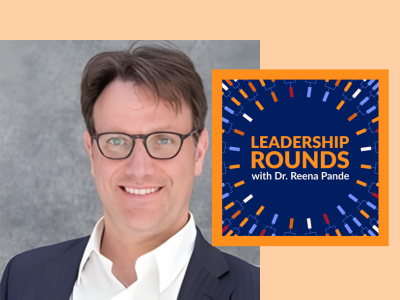
Healthcare leadership rarely follows a straight line. In fact, the leaders shaping the future of care are often those willing to step outside traditional paths, moving between academia, government, payer and provider organizations, venture, and ultimately, entrepreneurship.
In this episode of Leadership Rounds, Oxeon’s Dr. Reena Pande speaks with Dr. Will Schrank, a clinician-executive whose career spans nearly every corner of the healthcare ecosystem. Their conversation offers a masterclass in curiosity-driven leadership, mission alignment, and why clinicians must remain central to healthcare decision-making.
Will’s career began in academia at Brigham and Women’s Hospital, where he worked as a clinician-researcher in pharmacoepidemiology and pharmacoeconomics focused on medication access, affordability, and adherence. At the time, he assumed this work would define his professional life.
That assumption changed when a personal decision (his wife taking a role in the Obama administration) moved their family to Washington, DC. What followed was not a carefully orchestrated career pivot, but a willingness to engage with opportunity as it emerged. With the Affordable Care Act newly passed, Will joined the CMS Innovation Center, leading evaluation efforts during its earliest days.
The experience proved transformative. As Will reflects, he learned more in his first months in government than he had in years in academia, not because the science mattered less, but because implementation and influence mattered more. That realization reshaped how he thought about impact, teaching him that growth often comes not from perfect planning, but from stepping into moments of change with openness and humility.
After government, Will transitioned to CVS Health, at a time when it was still largely perceived as a retail organization and PBM rather than the healthcare company it is today. There, he worked to help CVS leverage its retail pharmacies and MinuteClinics as community-based partners in population health and value-based care.
One of the most defining moments of this chapter was CVS’s decision to stop selling cigarettes, an extraordinary example of a private company taking a clear stand on public health. Research conducted internally showed that a meaningful percentage of patients filling prescriptions for chronic conditions were purchasing cigarettes during the same visit. The inconsistency was undeniable.
The decision required leadership conviction and a clear mission. Subsequent research demonstrated that the move reduced overall cigarette sales regionally, not just within CVS stores, underscoring that clinical leadership within large organizations can drive decisions that reshape public health at scale.
Will’s next chapters took him deeper into system-level integration. As Chief Medical Officer at UPMC, he worked in a unique environment that combined a major health system and a health plan. This structure enabled true experimentation in aligning incentives, moving beyond “your money versus my money” toward shared accountability for outcomes, experience, and cost.
From there, he stepped into the national stage as Chief Medical Officer at Humana, where he focused on government populations and the integration of primary care, home-based care, and fully capitated payment models. Each move expanded the scope of his leadership from regional to national, institutional to community-based care, proving that some of the most powerful laboratories for healthcare innovation can be those where payment and delivery are designed together.
After years in large, complex organizations, Will made another pivot toward venture and entrepreneurship. While advisory roles offered breadth and exposure, he felt drawn back to a core problem that had followed him since his early research days: access and affordability in the era of transformative, high-cost therapies.
Cell and gene therapies can cure conditions once thought incurable, but at prices that challenge existing payment and delivery systems. For Will, this wasn’t an abstract policy issue; it was the next frontier requiring clinician leadership, creativity, and willingness to disrupt entrenched models.
Entrepreneurship, he notes, brings a different intensity. Every meeting matters. Every decision carries weight. The pressure is real, but so is the privilege. Leadership at smaller stages demands adaptability, resilience, and comfort with constant context-switching.
Despite the many transitions, Will emphasizes that certain principles have remained unchanged. Chief among them is a clear North Star: doing the right thing for patients.
This clarity, rooted in clinical training, simplifies decision-making even in complex business environments. It also anchors trust. Teams know what he stands for, and that shared understanding enables collaboration across disciplines.
What does change, however, is how leaders communicate. Large organizations require signaling through writing, town halls, and structure. Small teams require proximity, daily clarity, and visible alignment. Values stay constant; leadership mechanics must adapt to context.
As the conversation closes, Will offers a direct message to current and aspiring clinician leaders. Healthcare is a $4+ trillion industry, and many of the decisions shaping care are made by non-clinicians. That reality won’t change on its own.
If clinicians aren’t present to bring spine, perspective, and partnership, others will fill the vacuum. And patients, clinicians, and the system at large may not like the result.
“If we don’t help build the healthcare system of the future,” Will cautions, “we’re not necessarily going to like what we get.”
At Oxeon, we work closely with leaders navigating exactly these transitions: clinicians stepping into executive roles, operators moving between sectors, and organizations seeking leaders who can bridge clinical integrity with business execution.
Will’s journey highlights that the future of healthcare depends on clinicians who are willing to lead not just in exam rooms, but in boardrooms, policy discussions, and early-stage innovation.
Listen on Spotify or Apple Podcasts
Dr. Will Shrank has been a venture partner to the Bio + Health team of Andreessen Horowitz, a private venture capital firm, since January 2023. He previously served as Chief Medical Officer of Humana Inc., a leading care delivery and health plan administration company, from April 2019 to August 2022. In this role, his responsibilities included implementing Humana’s integrated care delivery strategy, with an emphasis on advancing the company’s clinical capabilities and core objective of improving the health outcomes of its members.
Prior to joining Humana, Dr. Shrank served as Chief Medical Officer, Insurance Services Division, of the University of Pittsburgh Medical Center (UPMC) from April 2016 to February 2019. From 2013 to 2016, Dr. Shrank held several positions with CVS Health Corporation, including Senior Vice President, Chief Scientific Officer, and Chief Medical Officer of Provider Innovation.
He also previously worked for the Center for Medicare and Medicaid Innovation, part of the Centers for Medicare and Medicaid Services (CMS), as Director, Research and Rapid-Cycle Evaluation Group.
Dr. Shrank began his career as a practicing physician with Brigham and Women’s Hospital in Boston, Mass. and as an assistant professor at Harvard Medical School. He received his B.A. in Psychology from Brown University and an M.D. from Cornell University Medical College. He also holds a M.S. in Health Services from the University of California, Los Angeles.


