
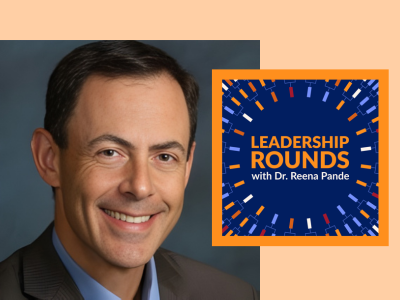
The future of healthcare will not be shaped by ideology or siloed expertise. It will be shaped by leaders who can hold clinical truth and business reality in balance. In this episode of Leadership Rounds, Dr. Reena Pande sits down with Rich Feifer, MD, one of the most experienced clinician–executives in the U.S. healthcare system, to unpack what it really takes to lead at scale.
Across decades of leadership roles spanning primary care, payer organizations, provider groups, and venture-backed innovation, Rich has seen healthcare from nearly every vantage point. His message is clear: clinicians don’t leave medicine when they step into leadership.
They expand it.
Rich began his career in internal medicine and loved clinical practice. His departure from full-time care was not driven by burnout or dissatisfaction, but by a different kind of ambition in a desire to improve care beyond the exam room. As he puts it, seeing one patient at a time eventually felt limiting. Leadership offered a way to scale impact from a panel of thousands to populations of millions. At various points in his career (including senior roles at Aetna, Medco, Genesis, and InnovAge), Rich reframed population health as an extension of clinical responsibility. Thirteen million lives, he notes, were simply a larger patient panel. This mindset of “I’m still caring for patients, just at a different altitude,” is foundational for clinician executives navigating identity shifts.
One of the most resonant themes in the conversation is identity. Medicine trains people for linear progression: pre-med, med school, residency, attending. Stepping off that track can feel disorienting and, at times, frightening. Rich names this explicitly. Leaving full-time practice required redefining how he saw himself and how others perceived him. Friends and family didn’t always understand. Neither did colleagues. But his advice is pragmatic and generous.
“Very rarely are you closing a door you can never reopen.”
For clinicians contemplating leadership roles, Rich emphasizes the importance of talking to others who’ve done it, crafting a clear elevator pitch, and remembering that purpose, not job title, defines continuity.
Having worked on both provider and payer sides, Rich dismantles one of healthcare’s most persistent myths of the system being divided into “good” and “bad” actors.
In reality, he argues, payers, employers, operators, and clinicians across healthcare are trying to do the right thing within constrained systems. Assuming positive intent doesn’t erase structural dysfunction, but it enables collaboration.
This perspective shaped his work at Aetna and beyond, allowing him to act as a bridge rather than an antagonist. For clinician leaders, it’s a reminder that influence grows faster through partnership than opposition.
One of the most candid moments in the episode centers on bias. Rich and Reena name something many clinician executives experience but rarely say aloud: physicians are often held to a higher standard in business settings.
Clinical leaders are frequently required to bring more rigorous data, deeper analysis, and clearer proof than non-clinical peers when proposing initiatives. The assumption, implicit or explicit, is that clinicians are “emotional” advocates rather than disciplined operators.
Rich’s response is unapologetic: Bring it on. Clinicians, he argues, should be able to meet that bar. Doing so strengthens credibility. He shares an example from InnovAge, where a clinical team built one of the most rigorous business cases he had ever seen around end-of-life care improvements. It proved that clinical excellence and business rigor are not competing virtues, but complementary ones.
Another critical lesson Rich imparts was figuring out that leadership success is not determined solely by being right. Medical training rewards individual problem-solving and speed. Organizations reward coalition-building. Clinician executives must unlearn the instinct to present “the answer” and instead invest in pre-alignment, allyship, and trust.
That means:
This shift from expert to orchestrator is one of the hardest transitions clinicians face, but one of the most important.
When it comes to building teams, Rich looks beyond résumés and actually searches for qualities that Oxeon also holds in high regard in our own team. He prioritizes:
Experience matters, but adaptability matters more. He is candid that even with strong search processes, hires sometimes don’t work out, and when that happens, humane, transparent exits matter. For early-career clinicians interested in leadership, his advice is to take on responsibility early, even without title or pay. Committee work, task forces, and informal leadership roles are how credibility is built long before job transitions.
Rich strongly believes that meaningful clinical practice experience matters, even for those ultimately pursuing executive paths. Not only for credibility, but for judgment. Having carried the responsibility of patient outcomes by making hard decisions, leading teams, and navigating uncertainty, creates a depth of perspective that cannot be simulated. Leadership effectiveness, he notes, is ultimately defined by followership. People must believe you understand their world.
Rich closes the conversation with what may be its most important insight: clinician executives must become multilingual.
That means fluency in:
Clinicians bring extraordinary expertise into leadership rooms, but impact depends on how that expertise is communicated. Lead with the punchline. Support it with data. Invite questions. Avoid overwhelming. Translate without diluting.
At Oxeon, we work daily with clinicians navigating these exact transitions into executive leadership, board roles, and CEO seats, and can attest to the fact that Rich’s career offers a roadmap grounded not in theory, but in lived experience. His story reinforces that healthcare will only change at scale when clinicians help lead it at scale.
Listen on Spotify or Apple Podcasts
Richard A. Feifer, MD, MPH, FACP, is a physician executive specializing in value-based care, geriatrics, and population health. He currently serves as Chief Medical Officer of InnovAge, a national provider of the Program of All-Inclusive Care for the Elderly (PACE), where he leads clinical strategy, quality initiatives, and care model innovation focused on improving outcomes for complex senior populations.
Prior to joining InnovAge, Dr. Feifer served as Chief Medical Officer at Genesis HealthCare, one of the largest post-acute and long-term care providers in the United States, where he led clinical transformation initiatives across skilled nursing and rehabilitation services. Earlier in his career, he held senior leadership roles at Aetna, where he focused on population health strategy, value-based care programs, and improving coordination across payer and provider systems.
Dr. Feifer is a board-certified internist and Fellow of the American College of Physicians. He received his M.D. from the Mount Sinai School of Medicine and his M.P.H. in Health Policy and Management from the Harvard T.H. Chan School of Public Health. He completed his residency in internal medicine at the Hospital of the University of Pennsylvania, where he also served as Chief Resident.


