
Healthcare doesn’t suffer from a shortage of ideas. It suffers from a shortage of durable execution and the kind of trust that makes change possible.
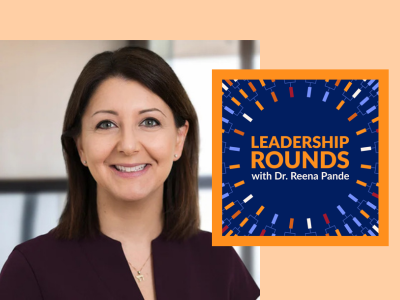
In Season 2’s penultimate episode of Leadership Rounds, Oxeon’s Dr. Reena Pande speaks with Dr. Mandy Cohen, MD, MPH, physician and former CDC Director, about what it takes to lead through complexity, from federal policy to statewide transformation to crisis response at national scale.
As with many great opportunities to learn from a seasoned mentor, what emerges is not a résumé recap, but a leadership framework. Technology is accelerating, but trust and change management will determine whether transformation sticks, and Mandy's insight is invaluable for understanding how.
Mandy credits her earliest exposure to healthcare’s fractures to her mother, a nurse practitioner who worked in emergency rooms, where gaps in coverage, access, and cost show up first. That “system view” deepened when Mandy worked in Washington, DC, and saw how payment and policy shape clinical reality.
But one clinical moment sharpened her thesis. A patient in a world-class academic setting received every test the system made easy to order, yet her most basic need went unaddressed until a member of the care team asked the question that wasn’t built into the workflow: Does she have enough to eat?
For Mandy, it wasn’t just a story about social determinants. It was a story about system design and the cost of building environments where the “whole person” can disappear in plain sight.
Mandy’s career includes multiple moments of being thrown into the deep end in roles she hadn’t necessarily done before, under conditions where the institution needed outcomes more than credentials.
Her healthcare.gov experience is a case study in modern leadership. When the system failed publicly, the job wasn’t simply policy, it was cross-functional execution under scrutiny: politics, communications, management, operations, and outcomes all at once. This taught her that operators don’t wait for perfect readiness. They raise their hand, learn fast, and build clarity amid chaos.
One of the most actionable insights from the episode is Mandy’s advice that trust is something leaders can measure, build, and protect.
At the outset of COVID, North Carolina Governor Roy Cooper told her plainly that the ability to navigate whatever came next would depend on whether the state could build and maintain trust. Mandy’s response was profoundly that of an operator. Then we should measure it, she thought.
From there, trust became tactical:
In other words, trust rises when leaders behave like adults in uncertainty: clear, consistent, accountable, and measurable.
Another powerful takeaway is Mandy’s view that the people who thrive in stable periods aren’t always the people you need in crisis (and vice versa). Strong leaders build teams with:
She also calls out a common hiring failure in confusing “domain familiarity” with “core leadership competency.” The best selection decisions balance both without dismissing leaders simply because their experience came from a different sector.
Mandy doesn’t mince words about what’s coming next: AI will change healthcare. But she believes the limiting factors won’t be the tools. They’ll be:
This is where clinician leaders matter most. They can translate between patient safety, operational reality, policy incentives, and public expectations to help set guardrails before trust erodes.
If you’re a clinician stepping into executive leadership, or an operator building the future of care delivery, Mandy’s playbook is refreshingly specific:
Listen on Spotify or Apple Podcasts
Related listening: If you’re interested in clinician operators shaping care delivery from the inside out, explore more episodes on Oxeon’s Leadership Rounds podcast here.
Mandy Cohen, MD, MPH is a physician and nationally recognized healthcare leader whose career spans clinical care, federal health policy, large-scale operations, and public health transformation. She served as the 20th Director of the Centers for Disease Control and Prevention (CDC) and is currently a National Advisor at Manatt Health.
Previously, Dr. Cohen led North Carolina’s Department of Health and Human Services, where she focused on modernizing Medicaid, integrating services to improve community health, and leading the state’s COVID-19 response with a strong emphasis on measurable public trust. She has also held senior leadership roles across the healthcare ecosystem, including work connected to value-based care and care delivery innovation, as well as serving as the executive vice president at Aledade and CEO of Aledade Care Solution.
Dr. Cohen earned her MD from Yale School of Medicine and her MPH from the Harvard T.H. Chan School of Public Health, bringing a clinician’s grounding to the work of building systems that deliver better outcomes at scale.


