
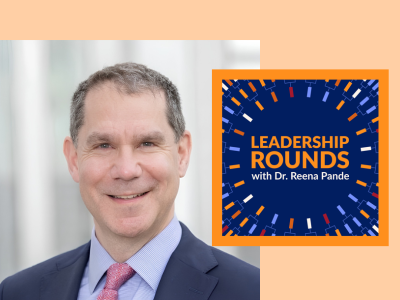
So why can't we scale it? Daymark Health CEO Justin Bekelman discusses the economics holding back cancer care innovation, why physicians are uniquely equipped to lead, and what it will take to bring evidence-based oncology to more patients.
When Justin Bekelman first met the patient in question, his job was to treat prostate cancer.
He did. Successfully.
It was 2010, and the patient had traveled from rural Pennsylvania to Penn Medicine, where Justin was helping introduce advanced proton therapy. The man had low-risk prostate cancer. Treatment went well.
Years later, the same patient returned with headaches.
This time, the diagnosis was metastatic lung cancer.
Looking back, Justin could see the painful contrast between the two experiences. The prostate cancer was the kind of disease that, with what we now understand, might never have even needed treatment.
The lung cancer was the disease that would ultimately take the patient's life.
“We cured him of a cancer that would never have actually harmed him,” Justin remembers. “And we missed the cancer that actually led to his death.”
It's a humbling admission from a clinician whose career has been otherwise defined by clinical excellence and rigorous research.
That experience followed Justin, and it wasn't about one doctor or one decision. It was about the system surrounding them. The healthcare system he knew was good at delivering sophisticated interventions, but far less effective at ensuring patients received the care they needed most.
Justin moved from practicing oncology to founding the Penn Center for Cancer Care Innovation, and ultimately left academic medicine altogether to pursue entrepreneurship as co-founder and CEO of Daymark Health.
His mission? We have evidence for better ways to deliver care, but far too few mechanisms for bringing them to patients at scale.
It was time to change that.
Before medical school, Justin worked in government policy at the U.S. Department of Defense and in strategy consulting. He was interested in the external forces shaping people's lives long before he entered clinical practice.
But one of his most formative experiences happened as a college student volunteering as an emergency medical technician. He remembered being excited to learn how to save people, though most calls weren't dramatic rescue missions. They involved people living with chronic illness, struggling with addiction, or avoiding healthcare because they distrusted the system or didn't believe it would help them.
By the time an ambulance arrived, their conditions had often deteriorated considerably. A community-based crew chief taught him to recognize the humanity beneath those circumstances and to communicate effectively with patients who were reluctant to accept help. The experience gave Justin an understanding that would stick with him: clinical outcomes are inseparable from the economic, social, and policy conditions surrounding patients. Medicine could help him treat the person in front of him, but he wanted to understand (and change) the systems shaping what happened before and after that encounter.
He describes these two forms of impact as intensive and extensive.
Intensive impact = the work clinicians do with individual patients
Extensive impact = what becomes possible when systems improve for entire populations
Justin wanted both.
That led Justin to build the Penn Center for Cancer Care Innovation (PC3I) at the University of Pennsylvania's Abramson Cancer Center.
Together, clinicians, researchers, technologists, and healthcare operators developed and rigorously evaluated new approaches to cancer care. They studied interventions that could improve clinical outcomes, reduce unnecessary utilization, and make cancer care more patient-centered. They explored virtual care, home-based treatment, and new ways of using technology to support patients, running randomized trials to identify what actually worked.
But there's a distinction between proving an intervention can work and making it part of everyday care.
At the center, Justin and his team had a saying. They’d say, “You never want to be known for doing good pilots.”
That sentiment captures a frustrating reality across healthcare. Academic medical centers are designed to generate evidence and advance medical knowledge. They can be extraordinary environments for experimentation. But moving innovation from a research environment into a real-world, repeatable operating model is fundamentally different.
An intervention can improve outcomes in a controlled environment, and it may even theoretically lower the cost of care. But its successful pilot doesn’t guarantee it can survive the financial and operational realities of the broader healthcare system.
So what happens after it’s been proven to work?
One of the clearest examples came during the pandemic. Prior to COVID, Justin and colleagues at Penn Medicine had already begun exploring how selected cancer treatments could move from hospitals into patients' homes.
The idea wasn't entirely new, but it had not become widespread in the United States.
Then COVID arrived.
Patients with cancer, many of whom were immunocompromised, understandably became concerned about entering their treatment facilities. Some began refusing treatment altogether because of the perceived risk of exposure. That didn’t make their cancer diagnoses any less urgent.
So Justin’s team mobilized. Because the infrastructure for a Cancer Care at Home program was already in development, Penn could expand home administration of eligible cancer treatments, including selected infusion therapies.
The results highlighted what could happen when an institution combined clinical expertise, operations, and a willingness to change its systems. According to Penn Medicine, its Cancer Care at Home program began in February 2020 and expanded nearly 700% during the early pandemic period (1). It has since become part of standard care. The program also reduced the practical burdens of cancer treatment: travel, wait times, repeat visits, and general disruptions to patients' lives.
But now a new question was popping up. If this could work at Penn, why couldn’t it work across the entire U.S.?
Traditional fee-for-service reimbursement rewards delivering billable services. But the value created by more proactive, coordinated, patient-centered cancer care doesn't always show up as a new billable service (in fact, it rarely does). In some cases, the benefit is that a hospitalization never happens. Or that an emergency department visit is avoided. Or that a patient receives care at home rather than in a more expensive setting. The patient is better off, and the healthcare system spends less. But the organizations investing in the intervention may not be the ones that capture the financial benefit.
Justin describes that misalignment plainly: the economic benefits of innovations that reduce the total cost of care can accrue primarily to the payer. That creates a really difficult business case for organizations that are trying to scale them.
But better clinical outcomes and better business economics should reinforce each other. Right? Unfortunately, too often, they don't.
It was a big, system-level problem Justin couldn't solve with another trial or pilot, so he started thinking about an entirely different pathway for cancer care innovation.
Justin had achieved what many physicians spend their careers pursuing. He’d built an acclaimed academic center, led major research programs, published extensively, and helped introduce new approaches to clinical care. But he knew he could make an even bigger impact.
For decades, healthcare has built pathways for translating scientific discoveries into commercial products. A drug moves through development, clinical testing, regulatory review, and eventually into broader clinical use. But what happens when the discovery isn't a drug?
What if it's a better system?
Maybe it’s for managing patients' symptoms, maybe it for providing earlier palliative care. Maybe it’s for coordinating treatment from home, or connecting patients with the clinical and social support they need between oncology appointments. These interventions can also be supported by rigorous clinical evidence, yet their pathway into widespread commercial practice was considerably less established.
So Justin came to believe that bringing those discoveries into the real world required a sustainable business designed around the care itself.
And that’s how Daymark Health came into view.
Daymark is a value-based oncology company partnering with health plans and existing oncology providers to deliver clinical, behavioral, and practical support to patients with cancer. Its care model brings oncology-trained nurses, NPs, social workers, and other team members into patients' homes and also connects with them virtually. It is designed to complement (not replace) a patient's oncologist. Rather than focusing solely on what happens during appointments, the model addresses what happens between them: symptoms, medication concerns, care coordination, emotional distress, financial challenges, and the everyday realities of living with cancer. The concept is grounded in evidence-based supportive oncology interventions.
The challenge is to deliver those interventions consistently, at scale, under financing arrangements that can sustain them.
One of Reena's central interests throughout Leadership Rounds is understanding what enables clinician executives to succeed beyond traditional clinical roles, and Justin's career is a particularly interesting case study.
He moved from practicing medicine and leading research to founding an innovation center, then to serving as CEO of a venture-backed company.
Those environments appear dramatically different at face value, but Justin argues that many of the most important leadership skills translate remarkably well.
Yet medical education has a bit of a branding problem. It doesn’t always explicitly teach clinicians to recognize those experiences as leadership development.
“By definition, physicians are leaders, whether they like it or not,” Justin explains. At Penn, he learned to exercise what he calls relational leadership.
Consider the complexity of moving cancer treatment into patients' homes. It required coordinating across clinical departments, service lines, operational teams, and organizations with different incentives and priorities. Justin didn't have direct authority over everyone involved. All of the work progressed through influence, shared purpose, and the ability to bring people together around a vision.
That was the experience that translated directly into entrepreneurship. That, and the ability to make decisions and keep moving. Clinical training can cultivate the capabilities that highly dynamic healthcare organizations actually need in this very moment.
Justin anticipates continued progress in cancer treatments and early detection over the coming decade. But, as his experience shows, he clarifies that discovering better treatments is not the same as ensuring patients have access to them. The next generation of cancer care leaders will need to advance the medicine and advance the systems that deliver it.
For Justin, leaving academic leadership to build a company was not a departure from his mission.
It was a way of pursuing it on his own terms. His advice to people contemplating a big career move is a simple one:
“Just do it.”
Because healthcare's future won’t be determined by breakthroughs alone. It’ll depend on which of those breakthroughs we can bring to those who need them.
In Episode 19 of Oxeon's Leadership Rounds, Dr. Reena Pande speaks with Justin Bekelman, MD, co-founder and CEO of Daymark Health, about cancer care innovation, value-based oncology, physician entrepreneurship, and the leadership required to scale evidence-based care.
🎧 Follow Leadership Rounds on Spotify or Apple Podcasts to catch next month’s conversation. If you are building a leadership team or looking for your next career move, talk to us.
Justin E. Bekelman, MD, is the co-founder and Chief Executive Officer of Daymark Health, a value-based oncology company advancing personalized cancer care through in-home and virtual clinical support delivered in collaboration with health plans and patients' existing oncology providers.
He is the founding director and former leader of the Penn Center for Cancer Care Innovation (PC3I) at the Abramson Cancer Center. He established PC3I to develop, rigorously evaluate, and scale new approaches to cancer care delivery, including patient-centered interventions, telehealth, home-based cancer treatment, and innovative oncology payment models. He has authored nearly 200 scientific publications and led research supported by the National Cancer Institute, American Cancer Society, Patient-Centered Outcomes Research Institute, and other funding organizations.
Before entering medicine, Dr. Bekelman served as Special Assistant to the Under Secretary of Defense for Policy at the U.S. Department of Defense and worked in management consulting, developing an early interest in the relationship between policy, business, and individual health outcomes.
He earned his undergraduate degree from Princeton University and his medical degree from Yale School of Medicine. His clinical training included Johns Hopkins Hospital and Memorial Sloan Kettering Cancer Center. He is board-certified in radiation oncology and continues to see patients through Penn Medicine.
At Daymark Health, Dr. Bekelman is bringing together clinical oncology, evidence-based supportive care, and value-based payment to address challenges that occur between traditional medical appointments. Under his leadership, Daymark announced a $20 million Series A in September 2025, bringing its reported funding to $31.5 million, and has established partnerships with health plans, including Blue Cross & Blue Shield of Rhode Island, to expand access to coordinated cancer care.


