
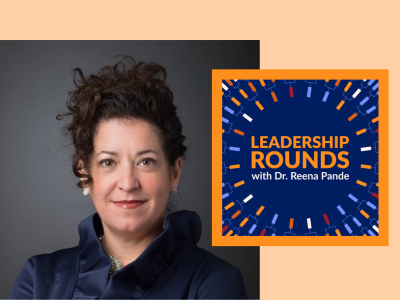
Key insights hiding in plain sight from Shamiram Feinglass
Sweaty brow. Elevated heart rate. Rapid breath.
Entering a corporate office for the first time in an executive capacity is not even close to the highest-stakes situation a clinician has ever experienced. But it can be the most nerve-wracking.
That’s because there’s a reset button that nobody talks about that gets pushed when a clinician walks into a boardroom.
Years of making decisions under pressure suddenly seem to count less. A lot less.
Leading multidisciplinary teams? Different. (Read: not as applicable. Not as good.)
Triaging when resources are scarce? Apparently not strategy.
Communicating life-changing information to patients and families in many different ways, in different languages, on different levels? Somehow not executive communication.
Reviewing failures in morbidity and mortality conferences so they are less likely to happen again? Evidently not organizational learning.
Dr. Shamiram Feinglass knows that feeling of disconnect intimately.
Today, she serves as a Managing Director at Manatt Health, an independent board director at Sandoz, affiliated faculty at Johns Hopkins Bloomberg School of Public Health, and is also a co-author of The 60-Minute Clinician MBA. Her career has included CMS, the U.S. Public Health Service, Zimmer Biomet, Danaher Corporation and Beckman Coulter, global pandemic leadership, public health, health policy, life sciences, diagnostics, governance, and consulting.
And looking backward, that career can appear almost meticulously designed to have brought her right where she is.
But it wasn't.
She allowed her real-time observations job by job to inform not just where she wanted to go next, but where she was needed. And that may be one of the most useful things we can learn from her.
In this month’s episode of Leadership Rounds, Shamiram (“Shami”) joins Oxeon’s Dr. Reena Pande to talk about the real path(s) from clinician to healthcare executive. They discussed what medicine prepares clinicians for extraordinarily well, what it skips teaching them altogether, and why too many health organizations still underestimate the leadership potential within their clinical workforce.
Shami grew up in San Francisco, CA, where service and healthcare access were embedded in everyday life. Her parents helped found a free clinic. She grew up around the Haight-Ashbury Free Clinic and Rock Medicine with the notion that people should be able to get care when they need it.
But that this wasn’t (and never has been) the norm everywhere.
So before medical school, her mother insisted she spend some real time in the “real world.” Shami took the advice, heading to Washington expecting to spend a year working in health policy.
But she stayed three. And she noticed something.
Healthcare policy decisions were being made, sure. Things were moving, getting done. But more often than not, clinicians were absent from the rooms where things were happening.
That would follow her for decades.
So, fast-forward: after earning both her MD and MPH at Emory and completing internal medicine and preventive medicine training, she joined CMS and the U.S. Public Health Service. What was supposed to be another short chapter became eight years living and breathing Medicare, health policy, reimbursement, crisis response, and government leadership.
“If I can unlock this mystery of payment,” she remembers thinking, then perhaps she could better understand how to improve access.
The instinct to understand the next level affecting patients rather than remaining confined to one plane of function became a defining characteristic of her career.
Shami’s move into industry was not part of a meticulously constructed career plan.
While participating in a federal roundtable spanning CMS, FDA, academia, and industry, she met an exec who eventually tried to recruit her into a global role overseeing clinical, regulatory, medical affairs, and medical education at Zimmer.
Like many of the outstanding clinicians we’ve heard from on this show, her initial response was to offer to help find someone else.
But the recruiter wanted Shami. A physician-policy leader who understood government and reimbursement was exactly the type of person they saw stepping into this multinational corporate leadership position.
So Shami took the job, but immediately did something unexpected.
She asked for an executive coach.
Not because she was failing (...she wasn't).
And her HR team initially hesitated at her request for an executive coach, largely because coaching was still viewed as corrective at that time. After all, she understood medicine. She understood government.
What was she worried about?
Shami explained that she viewed her request as acceleration. People who had spent their careers inside large corporations possessed knowledge and experience she didn't yet have.
“There are things I don't know how to do that you all know,” she explained, “and I don't really know what those gaps are until I hit them.”
That is an extraordinary executive instinct hiding inside a very simple notion:
Expertise and humility are not at odds with each other.
The strongest leaders possess both. One of the most important qualities in a collaborative leader is the humility to know there are things you don’t know, and being willing, excited even, to continue learning throughout your career.
Years later, Shami found herself frustrated by another persistent contradiction.
She and other accomplished clinician executives were successfully leading large organizations, yet still hearing that they were insufficiently strategic or (an old favorite) should “stay in their lane.”
So she and colleagues began articulating something business organizations had largely underestimated and overlooked: Medicine trains leaders. It simply uses different language for those skills.
Clinicians constantly sort problems by level of urgency, prioritize finite resources, work with incomplete information, and make highly consequential decisions.
That is strategy.
There is hierarchy. There are defined roles. Information arrives continuously. Decisions must be made quickly. Everyone needs clarity about responsibility. Everyone knows who to listen to, how to listen and respond, and where to step in and add their own input.
That is crisis leadership.
Medicine deliberately surfaces mistakes, examines them with peers, and asks what needs to change to prevent them from happening again.
That is organizational learning.
A clinician has to understand incredibly complex information deeply enough to communicate it clearly, but then adjust the message in order to meet the human receiving it where they are. There is a massively overlooked human element, a talent and a skill for building enough trust to make the next decision together. It’s often flippantly referred to as “bedside manner”.
But what it directly translates to is executive communication.
None of this means that every outstanding clinician will become an outstanding corporate leader.
But it does mean clinicians are not arriving at the leadership table empty-handed. Far, far from it.
Shami is equally clear about what medicine does not teach.
The financial statements. The corporate strategy. Supply chain. Board governance. Organizational communications. Capital allocation. Commercialization. Legal frameworks. The mechanics of operating a multinational enterprise.
Those are real gaps. Big ones.
But the mistake is believing clinicians have only two choices: remain in a clinical silo or leave it all behind to become experts in every other business function.
That is precisely the false choice The 60-Minute Clinician MBA was created to address. Shami and co-author Mahesh Krishnan designed it as a primer for clinicians entering business, covering financial literacy, strategy, leadership, operations, innovation, and career development.
Their goal? Fluency. Not functional impersonation. You do not need to become your CFO. You need to understand how your CFO thinks.
Great enterprise leadership requires a functional view, stepping back and seeing the whole system.
Reena pushed Shami on an important risk: couldn't clinicians hear this advice and conclude they need to know a little about everything?
But Shami drew a crucial distinction between breadth and depth.
Breadth means knowing enough about an organization's major functions to collaborate effectively. Depth is the expertise only you bring.
An executive's job is not to become proficient in every discipline. It’s to know the organization well enough to understand how each discipline contributes to the mission, and then allow everyone to thrive.
For clinicians, that deep vertical often remains incredibly valuable.
They understand
It is to surround that expertise with enough enterprise fluency to make it useful at greater scale.
The least technical lesson in the episode may be the most important.
Shami stressed that leadership is relational, not transactional. Trust is critical.
Trust = building relationships with the people making the product.
Trust = talking to the people making the decisions.
Trust = communicating with clinicians.
Trust = interacting with and understanding the consumers who will be using your product.
This is all particularly important for clinician executives. Clinical credentials open the door, but they do not automatically create influence. That happens when relationships are built.
Shami eventually became Chief Medical Officer for Danaher’s Life Sciences and Diagnostics businesses, responsible for spanning companies and teams worldwide.
But then came COVID, and, like for so many of us, everything shifted.
She became the medical leader coordinating the pandemic response across approximately 80,000 global associates. Suddenly, public-health training that might once have appeared as merely a tangential nice-to-have to corporate leadership became absolutely central to everything she was doing. Triage. Change management. And one lesson became unmistakable: her public health training and communications leadership abilities were not simply nice-to-have. In a crisis where new and confusing information could affect human behavior and human life, it was imperative that it be paired with the medical response.
Careers rarely develop in straight lines. But expertise compounds in ways that are difficult to predict.
Eventually, Shami and her colleague, Mahesh, realized clinicians making these transitions were largely figuring them out independently, and there was no shared playbook.
Worse, when experienced clinician execs left large organizations, they were often leaving their roles without any real pool of prepared replacements ready to move up through the ranks. Unlike other more traditional executive areas, there was no deep bench of clinicians lined up behind them. So it turned out that clinician leadership development was more than an individual career issue. It was a healthcare workforce issue.
Healthcare increasingly needs leaders who can operate across clinical medicine, policy, technology, finance, operations, and business. Those people don't simply appear. Organizations must identify them, expose them to broader responsibilities, set them up for success with mentors, teach them the language, and perhaps most importantly, give them some space to make mistakes.
Clinicians who have successfully crossed those boundaries have a responsibility to make the path clearer for the people following them.
Shami calls it “lifting as we rise.”
It would be easy to reduce this conversation to a checklist of business skills clinicians should acquire, but that would miss the point.
The larger lesson is about identity.
Clinicians moving into executive leadership don’t need to apologize for what they don’t know, but also can’t assume clinical excellence automatically makes them excellent business leaders.
Their training gives them something extraordinarily valuable. But, like all things in life, there is still so much to learn. Perhaps that is the defining duality of clinician leadership:
Know what only you know. Know what you don't. Learn enough to connect the two.
Confidently take the seat at the table. You belong there. Just remember to pull out the chair for the next clinicians.
🎧 Follow Leadership Rounds on Spotify or Apple Podcasts to catch next month’s conversation. If you are building a leadership team or looking for your next career move, talk to us.
Shamiram Feinglass, MD, MPH, is a physician executive, public-health leader, and Managing Director at Manatt Health, where she advises health systems and life science, medical device, diagnostic, and digital health organizations on strategy, medical affairs, policy, regulatory issues, reimbursement, commercialization, and organizational transformation.
Before joining Manatt, Shami held senior global leadership roles at Danaher Corporation and Beckman Coulter, including serving as Chief Medical Officer for Life Sciences and Diagnostics and Vice President of Global Medical Affairs and Policy. At Danaher, she built and led medical, government, reimbursement, and clinical affairs capabilities across a global portfolio and served as the medical leader, coordinating the organization’s COVID-19 pandemic response across approximately 80,000 associates worldwide.
Earlier, she served as Vice President of Global Medical and Regulatory Affairs at Zimmer Biomet, following nearly eight years in federal service. She worked as a medical officer at the Centers for Medicare & Medicaid Services and served as a Commander in the U.S. Public Health Service Commissioned Corps, where her work included federal health policy, Medicare coverage, and disaster-response assignments.
Shami currently serves in advisory or leadership capacities with organizations including Children’s National Hospital, Mental Health America, the Reagan-Udall Foundation for the FDA, and the Foundation for the National Institutes of Health. She is also a member of the Council on Foreign Relations and a Health Innovators Fellow of the Aspen Institute and a member of the Aspen Global Leadership Network.
She is co-author, with Mahesh Krishnan, MD, MPH, MBA, of The 60-Minute Clinician MBA: Pearls of Wisdom from Clinician Leaders to Help You Master Going from the Clinic to the C-Suite, a practical guide designed to give clinicians foundational fluency in financial literacy, strategy, operations, leadership, innovation, and executive career development.
Shami earned her bachelor's degree from Smith College, her MD from Emory University School of Medicine, and her MPH from the Rollins School of Public Health at Emory University. She completed her internal medicine residency at Oregon Health & Science University, a preventive medicine residency at Emory, and the Robert Wood Johnson Clinical Scholars Program at the University of Washington. She is board-certified in preventive medicine.
Outside healthcare, she is also a former BMX state champion and competed as a member of the USA BMX World Championship Team (a detail that sounds considerably less surprising after hearing her explain on Leadership Rounds that she took up BMX after being challenged to try it).


