
Dr. Reena Pande’s 23-year-old son (an engineer) recently texted her a New York Times article about AI in medicine with a three-word verdict: “Doctors getting replaced.” She smirked.
Days later, she sat down with the physician perhaps best positioned to take the bait.
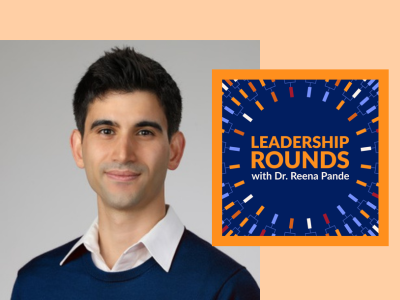
Sharif Vakili is a practicing primary care physician at Stanford Medicine and co-founder and CEO of UpDoc, which in June, announced FDA clearance for the first software medical device that uses a patient-facing large language model, cleared to deliver care that historically required a licensed clinician. On the latest episode of Leadership Rounds, Sharif explains what was actually cleared, why he refuses to call it an “AI doctor,” and why the future he is building needs more clinicians, not fewer.
SPOILER ALERT: Doctors aren’t getting replaced. Not on Sharif’s watch.
UpDoc’s cleared device supports insulin management for adults with type 2 diabetes. Patients interact by voice or text. The AI titrates insulin within parameters set by the patient’s own physician, triggers follow-up labs, and documents the entire intervention in the electronic health record, between visits, without an appointment. The clearance follows a Stanford Medicine clinical trial published in JAMA Network Open, and the platform is now in initial deployments at Cleveland Clinic, Allegheny Health Network, and UCSF Health.
UpDoc has raised $18 million in oversubscribed seed financing from investors including the American Diabetes Association, Eli Lilly and Company, Mayo Clinic, Polaris Partners, Section 32, yes, and Oxeon. (We are proud to have backed UpDoc’s thesis before the FDA did!)
“This FDA clearance marks a historic milestone for the field and the beginning of a new era in clinical care,” Vakili said in the company’s announcement, “where clinicians will be able to deploy clinical AI agents to help complete tasks autonomously on their behalf, much like engineers deploy coding agents today.”
The founding insight behind UpDoc came from frustration. In 2020, as remote patient monitoring (RPM) companies multiplied in COVID’s wake, Sharif was spending his time as a venture capitalist at Polaris Partners. He was also seeing patients two half-days a week, and kept running into a question no one could answer: when does a physician actually need 16 days of data?
The billing codes rewarded collection, so companies collected. What they rarely did was change anything. Worse, they fragmented care: programs enrolled patients directly, outside the primary care relationship, sometimes without the physician’s knowledge. More data; not better care.
With co-founder Ashwin Nayak, MD, a physician-engineer and clinical informaticist he met during training at Stanford, Sharif coined a term for the alternative. Remote patient intervention (RPI) has a precise definition: remote monitoring data, acted on by a clinical AI, to deliver care. And “clinical AI” has a threshold definition of its own: AI doing something that would historically have taken place in an encounter with a licensed provider. Sharif’s shorthand is what the resident can do when they sign the order, and the medical student cannot.
That is the line UpDoc just became the first company to cross with FDA clearance.
Unlike direct-to-consumer “doctor ChatGPT” products, UpDoc is enterprise-facing and EHR-integrated. It coordinates with the physician and drops a note in the chart the way a physician would. That architecture is a safety argument as much as a business one: an AI managing heart failure medications without the patient’s full record cannot see the recent echo, the renal function, the drug–drug interaction, or who is checking the potassium after a diuretic change. “It could be fatal, potentially, if you’re not doing it thoughtfully,” Reena notes in the episode.
Sharif’s framing of the opportunity is the episode’s thesis. “We should not be doing old things in a new way. We should be doing new things in a new way.” The point of clinical AI is not to automate the visit, it is to change the care delivery model from episodic to continuous so clinician time shifts to exception management and to patients who need a human.
The conversation’s sharpest structural insight: technology adoption in healthcare routinely creates beneficiaries everywhere except the clinic. “When technology gets adopted, there are a lot of beneficiaries,” Sharif says, “but oftentimes the clinician’s extra work and coordination becomes part of somebody else’s margin.”
In fee-for-service, a physician who uses asynchronous tools to become more productive bills less. They are penalized for efficiency. In value-based arrangements, the incentives flip, meaning clinical AI lets a primary care physician safely manage a larger panel, or spend more time with the same one. Sharif argues the technology may itself accelerate payment reform, because digitized, auditable workflows make two-sided risk contracts more honest. Reena’s summary is a line to remember here, too: care is reimbursed episodically, but “humans function in a continuous way.”
Here the conversation turns to the text from Reena’s son that kicked off the conversation, and the question Oxeon lives inside: talent. Roughly one-third of UpDoc’s employees are physicians. They aren’t advisors. They are engineers, product builders, and operators. Sharif cites research that physician founders outperform in healthcare, and offers his own explanation: the “get it” factor. “I cannot count the number of times I’ve had conversations with very ‘important people’ who don’t get it at all,” he says. The nuances of clinical practice (workflow, trust, risk) are earned knowledge, and they must touch “every single inch of surface area of the product.”
The scarcest archetype: the physician-engineer. Vibe coding, Sharif notes, only gets you so far. Real back-end architecture knowledge changes what the patient experiences. For boards and CEOs, the implication is uncomfortable and useful: if your AI strategy has no clinicians building the product (not blessing it, building it) you are betting against the pattern.
To clinicians eyeing the field, his message is generous: “Don’t be discouraged … If you know 20% of what you’re doing, you’re ahead.”
Sharif is bullish on clinical AI and blunt about its risk: deskilling. Early studies already show some tools eroding clinician skills. His analogy: “It’s like being a writer… Make sure you can write before you use these new tools.” Done thoughtfully, he argues, AI raises the value of clinical acumen. The gap between a physician’s judgment and an algorithm’s output is precisely where the physician earns their keep. Done lazily, the tools flatten that judgment. Training programs, he suggests, should protect time for reflection and building.
Asked for his crystal ball, Sharif offers a distinctly American paradox: the same forces that produced “this obscenity of a healthcare system” also produced the world’s greatest engine for building technology. Digital health’s first wave never bent the cost curve. Clinical AI that truly closes the loop, with honest pricing, auditable workflows, and physicians in command, could be the first technology that does. “We have an opportunity,” he says. “We have all the pieces.”
His son may yet join healthcare, Reena jokes. On the evidence of this episode, the field will need him alongside a great many physicians who can build.
🎧 Follow Leadership Rounds on Spotify or Apple Podcasts to catch next month’s conversation. If you are building a leadership team for the clinical AI era, talk to us.
Sharif Vakili, MD, MBA, MS, is the co-founder and CEO of UpDoc, the clinical AI company behind the first FDA-cleared software medical device with a patient-facing large language model, a milestone announced in June 2026. UpDoc’s platform, validated in a Stanford Medicine-led clinical trial published in JAMA Network Open, enables physicians to deploy AI agents that deliver continuous, EHR-integrated care between visits, and is in initial deployments at Cleveland Clinic, Allegheny Health Network, and UCSF Health.
A practicing primary care physician, Dr. Vakili pioneered Remote Patient Intervention (RPI), an AI-driven care model that helped establish the field of clinical AI. He serves on the clinical faculty at Stanford Medicine and teaches at the Stanford Graduate School of Business.
Before founding UpDoc, Dr. Vakili spent seven years in venture capital at Polaris Partners, where he served on the boards of biotechnology and health services companies. He previously hosted The Doctor Is Out, a podcast exploring physicians’ careers beyond the bedside.
Dr. Vakili completed his internal medicine residency at Stanford, and holds an MD from the Johns Hopkins University School of Medicine, an MBA from Harvard Business School, and a BS and MS in Biology from Yale University.
As defined by UpDoc, clinical AI is artificial intelligence that performs a task that would historically have required an encounter with a licensed provider, delivering care, not just supporting it.
The FDA granted 510(k) clearance to UpDoc’s prescription software medical device supporting insulin management for adults with type 2 diabetes, the first cleared software medical device with a patient-facing large language model.
RPI = remote monitoring data, acted on by a clinical AI, to deliver care, closing the loop that remote patient monitoring (RPM) leaves open.
No. UpDoc’s platform operates within physician-set parameters and is designed to shift clinician time toward exception management and patient relationships. CEO and physician himself, Sharif Vakili argues clinical acumen becomes more valuable as these tools scale.


