
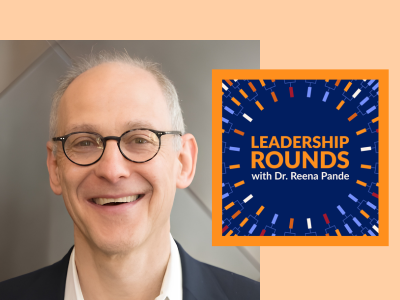
At first glance, Dr. Ezekiel Emanuel’s newest book, Eat Your Ice Cream, sounds playful, even a little contrarian. But beneath the jovially provocative title is a serious argument: modern wellness culture may actually be distracting us from the things that matter most.
In a special live episode of Leadership Rounds, recorded in Nashville, TN, Dr. Reena Pande sat down with the physician, bioethicist, healthcare policy architect, and longtime public intellectual for a wide-ranging conversation about wellness culture, artificial intelligence, chronic disease, loneliness, empathy, and the future of healthcare itself.
The result was less a traditional book discussion and more a candid interrogation of how healthcare (and society) defines a meaningful life.
Zeke explained that the inspiration for Eat Your Ice Cream came after reading an increasingly popular book on longevity and optimization that was dominating wellness culture at the time.
“It just pissed me off,” he admitted.
His frustration wasn’t with the emphasis on the importance of health and wellness itself. It was the growing tendency to treat wellness as an end goal rather than a means to living a fuller, more connected life.
“The real thing that incensed me,” he went on, “was the increasing tendency to make wellness into a kind of religion.”
In his view, much of today’s wellness ecosystem has become overly focused on data collection, tracking, optimization, and self-surveillance. This self-information overload often comes at the expense of joy, spontaneity, and relationships.
That critique extended directly to wearables and self-tracking devices.
“I highly recommend getting rid of your Oura rings,” he joked to the audience, arguing that constant monitoring consumes mental energy without meaningfully improving wellbeing for most people.
Instead, Zeke argues that true wellness is built on six foundational pillars:
One of the evening’s central themes was loneliness and the growing body of research linking human connection to longevity and health outcomes.
Zeke pointed to the landmark Harvard Adult Development Study, an 85-year longitudinal study that consistently found that close relationships are among the strongest predictors of happiness, longevity, lower disability rates, and overall well-being (1).
“The biggest predictor was social interactions,” he explained. “How many close friends you have, how intense those friendships are, how many acquaintances you have.”
The impact isn’t merely psychological. It’s biological.
Zeke says research increasingly shows that loneliness elevates stress hormones, increases inflammation, weakens immune response, and correlates with worse cardiovascular outcomes.
Meanwhile, strong social ties appear protective across nearly every major health metric.
Unfortunately, Zeke warned, it feels as though society is moving in the wrong direction.
People increasingly eat meals alone. Social isolation is rising. Younger generations, particularly Gen Z, report fewer close friendships than previous generations.
His prescription was surprisingly simple: talk to people.
He described chatting with strangers on airplanes, trains, and in public spaces. He didn’t suggest that every interaction could become profound, but even small moments of connection matter.
“Beginning that conversation really is a virtuous act,” he said. “Not only is it good for you, it’s good for them.”
The conversation then shifted from human connection to one of healthcare’s fastest-moving forces, our focus for the first few episodes of this season: artificial intelligence.
Unlike many healthcare leaders who remain cautious or skeptical, Zeke made it clear he is broadly optimistic about AI’s long-term role in medicine.
“I’m actually pretty bullish on AI,” he said.
He pointed to emerging research showing that AI systems already perform exceptionally well in several domains, including differential diagnosis generation, chronic disease management, and patient communication.
One particularly striking example involved a small Stanford study comparing autonomous AI management of newly diagnosed diabetic patients against standard physician-led care (2).
The AI-guided patients reached stable insulin dosing in just 15 days.
The physician-managed group had still not stabilized after 56 days.
For Zeke, chronic disease management represents one of healthcare’s greatest opportunities for AI-driven improvement.
“Probably the place our healthcare system sucks the most is in managing chronic illness,” he said candidly.
AI systems can continuously monitor patients, consistently follow evidence-based guidelines, and intervene earlier than traditional clinical workflows would allow. If implemented correctly, he believes AI could dramatically reduce complications from diabetes, hypertension, and other chronic conditions while simultaneously lowering healthcare costs.
Perhaps the most uncomfortable moment of the evening came when the conversation turned to empathy.
Zeke brought up a handful of emerging studies showing that patients often rate AI-generated communication as more empathetic than physician communication.
Why?
Because AI systems consistently validate emotions, repeat information clearly, reassure patients, and maintain calm, attentive communication patterns. That observation led to a broader reflection on medical education itself.
For decades, medicine has heavily prioritized IQ, test scores, memorization, and technical expertise. But in a future where information retrieval increasingly belongs to machines, he argued that emotional intelligence may become the defining skill of exceptional clinicians.
“More IQ is not going to make you a better doctor. More EQ is going to make you a better doctor.”
He challenged healthcare leaders to rethink how clinicians are trained, evaluated, and selected, not simply for technical mastery, but for communication, empathy, and human connection.
Despite the evening’s extensive focus on AI, automation, and digital health transformation, the conversation ultimately circled back to something remarkably analog: dinner parties.
When asked what single behavior change could most improve people’s lives, Zeke didn’t recommend a supplement, wearable, or optimization routine.
He recommended inviting people over for dinner.
For him, dinner parties represent what he calls a “wellness trifecta”:
In other words: a reminder that health is not simply the absence of disease or the optimization of biomarkers, but the ability to live a full and meaningful life with other people.
And in an era increasingly consumed by metrics, algorithms, and self-improvement culture, that may be the most radical healthcare insight of all.
Listen on Spotify or Apple Podcasts
Related listening: If you’re interested in clinician operators shaping care delivery from the inside out, explore more episodes on Oxeon’s Leadership Rounds podcast here.
Dr. Ezekiel J. Emanuel, MD, PhD, is Vice Provost for Global Initiatives and the Diane v.S. Levy and Robert M. Levy University Professor at the University of Pennsylvania.
He holds appointments in the Department of Medical Ethics and Health Policy at the Perelman School of Medicine and the Department of Health Care Management at the Wharton School.
A practicing oncologist and internationally recognized leader in health policy and bioethics, Dr. Emanuel serves as a Special Advisor to the Director-General of the World Health Organization, Senior Fellow at the Center for American Progress, and member of the Council on Foreign Relations.
He previously served as founding chair of the Department of Bioethics at the National Institutes of Health and was instrumental in drafting the Affordable Care Act during his time advising the White House Office of Management and Budget and National Economic Council.
Dr. Emanuel is one of the most widely cited bioethicists in history, with more than 350 publications and 16 authored or edited books. His newest book, Eat Your Ice Cream, was published in 2026.
His honors include election to the National Academy of Medicine, the American Academy of Arts and Sciences, the Association of American Physicians, the Royal College of Physicians, and the American Philosophical Society. He was also named the 2026 recipient of The Hastings Center Bioethics Founders Award.
Dr. Emanuel earned his MD and PhD from Harvard University, an MSc in biochemistry from Oxford University, and a BA in chemistry from Amherst College.


