
From diagnostics to drug discovery, the conversation around AI in healthcare has really reached a fever pitch. Headlines promise transformation at every level of the healthcare system. But beneath the hype lies a more practical (and frankly, much more urgent) question:
Where is AI actually delivering value?
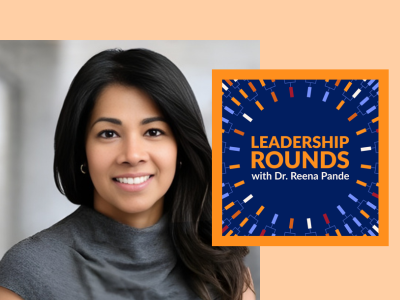
In Episode 12 of Leadership Rounds, Dr. Reena Pande sits down with Mary Presti, a senior executive at Microsoft’s Health & Life Sciences division and former bedside nurse, to explore what it really takes to scale AI in healthcare.
According to Mary, the industry is entering a new phase. The last two years have been about experimentation, but we’re moving into a new era focused on scale.
Healthcare organizations are ready to make strides beyond pilots and proof-of-concept models toward enterprise-wide deployment. But scaling AI introduces new challenges in governance, trust, workflow integration, and measurable ROI, and critically, not all use cases are created equal.
While much of the conversation focuses on high-impact clinical applications like diagnostics, Mary points to a different (and much more human) starting point: The friction around care itself.
From documentation to coordination, clinicians spend a significant portion of their time on tasks that detract from patient care. These “surround care” activities are often repetitive and predictable, which is why automative AI is able to gain significant traction in their potential management.
As Mary explains, these are the areas where:
And critically, this is an area where clinicians can feel immediate relief at implementation.
One of the most compelling ideas from the conversation is a reframing of how AI should show up in healthcare. For years, technology has inserted itself between clinicians and patients through screens, clicks, and documentation requirements that, admittedly, have caused concern on both sides of the equation.
But AI can change that. Mary tells us that the real promise of AI is the ability for technology to assist dramatically and then fade into the background, so human connection can return to the center of everything we do in patient-facing healthcare.
Ambient AI tools, such as clinical copilots, are already demonstrating this shift by reducing the documentation burden and allowing clinicians to stay much more present with their patients.
Despite rapid innovation, one risk remains clear. Technology built without clinicians will struggle to gain trust. Mary emphasizes the importance of clinician involvement across the lifecycle. Their input is imperative in:
This is not just about usability. It’s about credibility. Without clinician input, even the most advanced tools will fail to gain adoption.
As AI reshapes healthcare, it is also creating entirely new roles, such as:
These roles sit at the intersection of clinical expertise, leadership, and technology and require a new kind of hybrid skillset.
Perhaps the most important takeaway from this conversation is what won’t limit AI in healthcare.
It won’t be the technology. Instead, the true constraints are deeply human:
Healthcare systems must not only deploy AI, but help clinicians understand, adopt, and trust it.
Looking ahead, Mary predicts that many of today’s workflows will soon feel outdated. From beepers and fax machines to fragmented data systems, the inefficiencies we accept today may seem unimaginable in a decade. But progress will depend on thoughtful implementation, not just innovation.
AI will not transform healthcare on its own.
It will require clinicians, operators, and leaders working together to ensure it solves the right problems at scale and with trust.
Listen on Spotify or Apple Podcasts
Related listening: If you’re interested in clinician operators shaping care delivery from the inside out, explore more episodes on Oxeon’s Leadership Rounds podcast here.
Mary Varghese Presti is a senior healthcare technology executive with over 25 years of experience leading growth, innovation, and transformation across global healthcare and life sciences organizations.
She currently leads Portfolio Evolution and Incubation for Microsoft’s Health & Life Sciences division, where she focuses on developing generative AI-powered clinical workflow and productivity solutions across physician, nursing, coding, and revenue cycle domains.
Prior to Microsoft, Mary served as SVP and General Manager of Dragon Medical at Nuance Communications, where she led a global P&L exceeding $600M and incubated next-generation ambient AI solutions for the nursing workforce.
Earlier in her career, Mary held leadership roles at Pfizer, where she helped redesign commercial models in response to healthcare reform and the rise of real-world data, as well as in management consulting at Booz Allen Hamilton, advising on health policy, population health, and technology adoption.
Mary began her career as a pediatric nurse at Johns Hopkins Hospital, an experience that continues to shape her approach to innovation and patient-centered care.
She holds a Bachelor of Science in Nursing from the University of Pennsylvania School of Nursing and a Master of Public Health from Johns Hopkins University.
Mary has been recognized as a Healthcare Luminary by the Healthcare Businesswomen’s Association and received the Alumni Award for Innovation Practice from the University of Pennsylvania.


