

A companion argument to the one making the rounds in boardrooms right now — that healthcare's leadership pipeline needs to widen to capture leaders with genuine AI and digital fluency — deserves equal airtime: none of that matters if the person in the seat doesn’t have the operating discipline and expertise to run the organization and steward its future.
This issue came into focus through feedback from dozens of industry friends on a recent LinkedIn article I published, many of them the CEOs and CFOs of nonprofit health systems who I was writing about. Of course they had something to say. The general theme of the feedback was this: innovation is everyone’s focus right now, especially with the dynamic AI business and clinical environment, but that right executive for any C-suite role must start with operating expertise and discipline. In other words, innovation matters, of course, but it can’t take replace a fanatical focus on the day-to-day Xs and Os.
That's not a rhetorical hedge. It's the operating reality most health system boards and C-suite teams face in this very moment. The median health system operating margin ran just 0.4% year-to-date through March 2026, and national operating margins fell 13% comparing February 2026 to February 2025. Labor costs (still roughly 56-60% of total hospital expense, and up more than $42 billion industry-wide between 2021 and 2024) keep climbing even as volumes stay strong, but often flat. Non-labor costs, driven by drugs and supplies, grew 9% year over year through the end of 2025. Meanwhile, throughput is tightening in the wrong direction: adjusted discharges down 3%, ED visits per day down 4%, OR minutes per day down 5%, average length of stay up 4%.

That's not a technology problem, albeit technology can be helpful in driving efficiency and better throughput. This is an execution problem, and it's the one most likely to determine whether an organization is still solvent in three years.
We think it’s tough now? Let’s fast-forward a year, when we will be facing the impact of Medicaid cuts on top of this year’s ACA enrollment losses. It’s like the post-BBA era in 1997 all over again, but on steroids.
None of this argues against hiring leaders who understand AI, digital tools, or where healthcare is headed technologically. In fact, those skills and mindset are critical. This is an argument against letting that conversation crowd out the harder, less exciting question every board exists to answer: can this person actually run a hospital or health system under the financial and operational pressure it's under right now? Can they make the tough choices and “make the main thing the main thing?”
Operational excellence isn't a buzzword on a job description. It's the discipline of managing labor cost per adjusted discharge, holding the line on length of stay, keeping the OR schedule full, protecting margin on every payer contract, and doing it all while the clinical staff is stretched thin and patients are sicker with more complex, compounding illnesses than they were five years ago. It's exceedingly unglamorous. It rarely shows up in a splashy press release. And it is, without exception, the thing that keeps the lights on long enough for any technology strategy to matter at all.
Boards that lose sight of this tend to make a predictable mistake: they get dazzled by a candidate's command of AI strategy or digital transformation vocabulary and underweight the operating track record that would actually predict performance. A hospital CEO mis-hire is one of the most expensive mistakes a board can make. Typically, it sows 12 to 24 months of operating disruption, erodes confidence in an organization’s own leadership, and ignites a second search that is now urgent, public, and far harder to run as efficiently as the first one would have been. One of the things that drew me to Oxeon was the team’s track record identifying the rare leaders with the ability to see transformative potential and harness it into operational rigor that yields measurable results... on the first try.
Part of what makes this moment unusually unforgiving is that the modern hospital CEO is expected to lead across finance, care delivery, workforce culture, regulation, and technology simultaneously, yet most board accountability frameworks haven't caught up. Many systems still evaluate CEO performance primarily on budget adherence and quality scores, which is necessary but wildly incomplete. Many trustees are themselves years removed from day-to-day hospital operations. More challenging operating environments, broader job descriptions, and boards that are not always equipped to evaluate execution ability in the interview room are exactly what push search committees to optimize for the wrong signal.
The widening gap between well-capitalized systems with scale and negotiating leverage and smaller (or rural) facilities running on thin or negative margins only raises the stakes. A system with little room for error cannot afford a leader who is strong on vision and technology fluency but weak on the blocking and tackling of labor management, revenue cycle discipline, patient acquisition and retention, patient experience, and throughput, because in that environment, operational missteps compound into existential ones far faster than they used to.
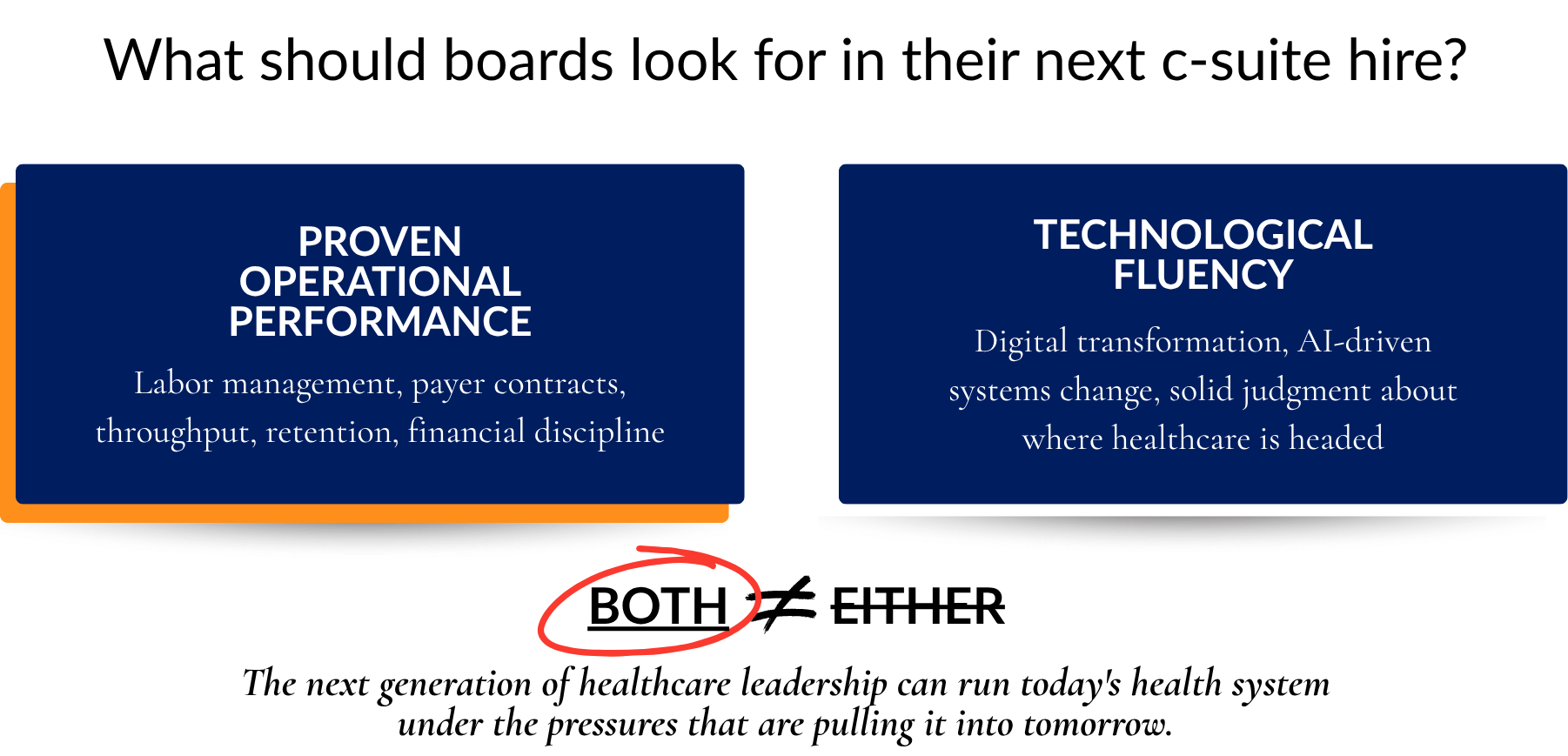
None of this means boards should default back to the safest, most traditional operator on paper and call it a day. The point isn't choosing between operational excellence and technological fluency; it's refusing to let the more interesting conversation about the latter quietly displace the harder evaluation of the former. The strongest candidates for today's hospital and health system C-suite roles will have both: a demonstrated, provable record of operational and financial performance under pressure, plus the judgment to concurrently guide an organization through AI-enabled change without losing the fundamentals that keep it solvent. Boards that search for one at the expense of the other are setting their next hire up to fail, regardless of which direction they lean.
This is where the discipline of a search process matters as much as the criteria it's built around. A search that spends its energy chasing the most technologically fluent candidate on the market without rigorously testing for execution ability is optimizing for the wrong variable. You can’t overlook how a person has actually managed labor cost, payer contracts, throughput, and workforce retention under real, unrelenting pressure. Conversely, a search that only screens for operating pedigree risks installing a leader who manages today's hospital well, but has no idea how to lead it through what's coming tomorrow.
Resumes and LinkedIn profiles only tell part of the story. Operating excellence is a mindset.
The team at Oxeon has built our search practice on the belief that this balance can't be shortcut. As experienced operators who have built and run healthcare organizations ourselves, we evaluate candidates on demonstrated judgment and performance under real operating pressure first, then assess fit for where the organization and the industry are headed. That combination is exactly what a board vetting its next C-suite leader should test for, and precisely what gets lost when a search process chases the more fashionable half of the conversation at the expense of operating discipline.
As you think about your next C-suite search, resist the urge to let either extreme define the brief. The leader your organization needs isn't the most AI-fluent candidate in the pool, and it isn't the most operationally tenured one either. It's the person who can prove, with real numbers and real outcomes, that they can run a complex health system under financial pressure while also being capable of leading it into a very different future. Finding that person requires a search partner who knows the difference between a résumé that sounds impressive and a track record that actually holds up, a partner who won't let either side of this conversation crowd out the other.
Brandon Edwards is a Partner at Oxeon. With 35 years of experience in healthcare, Brandon is an experienced operator and executive who spent the last 17 years as CEO of the two (successively) largest healthcare marketing and managed care consulting firms serving health services companies.
With experience across hospitals and health systems, digital health, and healthcare services, Brandon partners with leading organizations and investors to build high-performing executive teams capable of navigating complex transformations, strong growth, and long-term sustainability. He joined Oxeon with the conviction that real change in healthcare is only possible through exceptional leaders and teams, and that all sectors of healthcare need access to bigger and better and talent pools in the future.
Prior to joining Oxeon, Brandon served as CEO at Unlock Health, where he now serves as Board member and Executive Advisor to the firm’s managed care consulting clients. Brandon previously spent 13 years as Founder and CEO, then Executive Chair, of Revive Health. He began his career managing political campaigns before transitioning to leadership roles in marketing firms and a 5-year stint inside Tenet Health, including Corporate Ventures.
Brandon is a frequent speaker at healthcare industry events, and he authored Authentic Healthcare Marketing in the Post-Truth Era and The Price of Care, as well as co-authoring The Gospel of Growth. With an extensive network spanning the health services world, he has constructed executive leadership teams in three different companies, built from zero to one, and scaled businesses to $100 million in revenue.
Based in Nashville and Scottsdale, Brandon holds an MBA from UCLA and a BA from University of California, Santa Barbara. He is married with three grown children and a very handsome French Bulldog.


